SEO & Performance

Rank higher. Load lighter

Image-heavy pages are the ones that slow a site down and the ones search engines understand least. FotoGrids ships the speed work switched on by default, and gives every image the metadata search engines actually read.

The three numbers that count

Galleries are where usually Core Web Vitals go wrong

A page full of images is the usual reason a site fails these thresholds. Each one has a specific cause, and each has a default in FotoGrids that works against it.
2.5s
LCP target

Largest Contentful Paint

Usually the hero image of a gallery. Oversized source files and images loaded before they are needed are the two normal causes.

Lazy loading
Image sizes
0.1
CLS target

Cumulative Layout Shift

The jump that happens when images arrive and push the page around. Reserved dimensions and consistent cropping stop it before it starts.

Image sizes
Cropping
200ms
INP target

Interaction to Next Paint

How fast a gallery responds to a tap — opening the Lightbox, changing a filter, moving to the next page of a large set.

Minified assets
Caching

Thresholds above are Google’s published Core Web Vitals targets. Every item in this block is in the free plugin.

Speed, by default

Nothing to configure to be fast

Performance settings that other gallery plugins treat as advanced options are already on when you install. You can change them, but you do not have to find them first.

Lazy loading

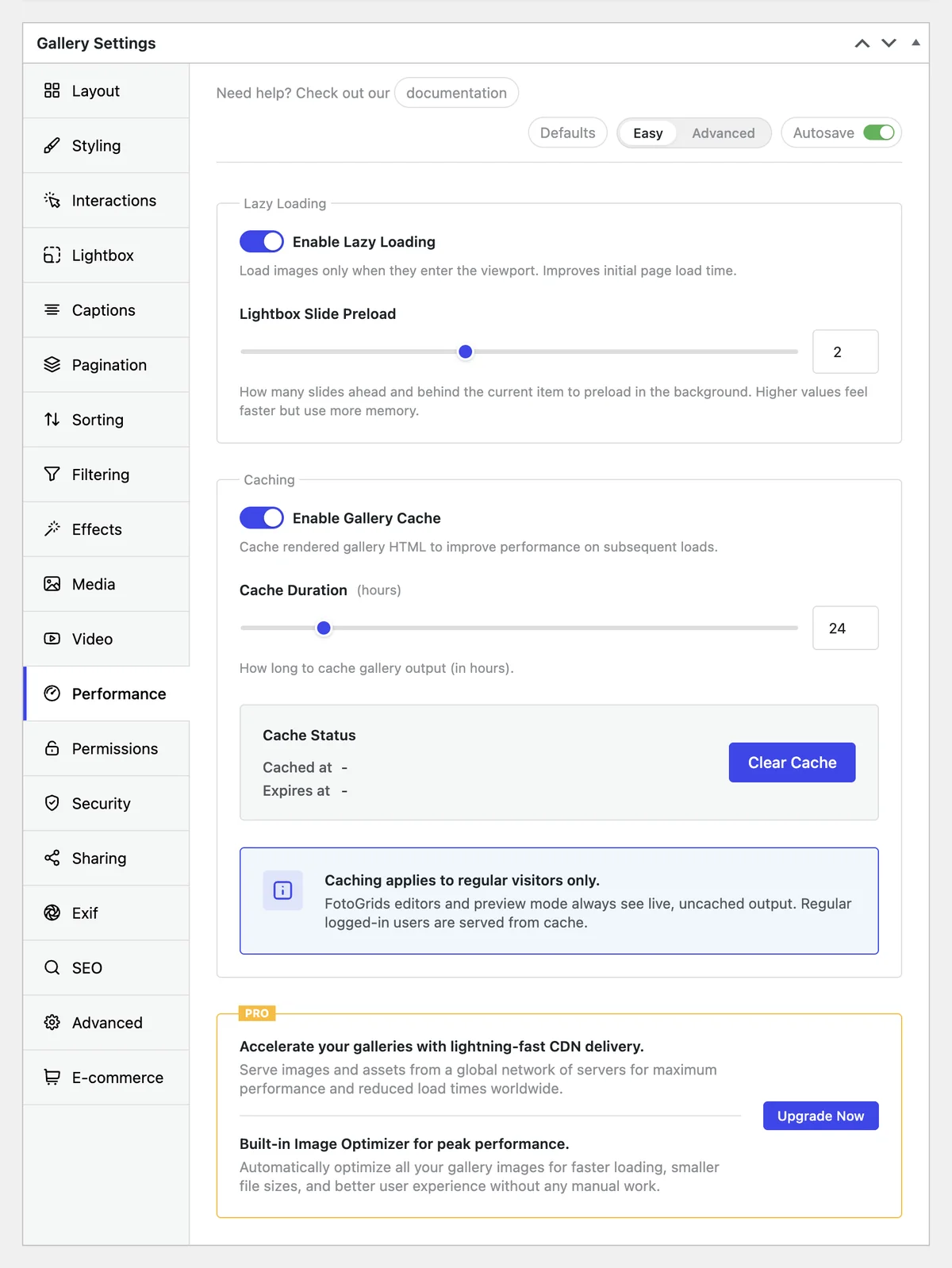
Images load as they come into view. Built in, zero configuration, no page-speed penalty for a long gallery.

Enhanced caching

Repeated gallery processing is cached, so browsing stays smooth as the library grows rather than degrading with it.

Image sizes & cropping

Serve a thumbnail-sized file for a thumbnail. Consistent crops also mean the layout doesn't shift when images land.

Pagination

Split a 400-image gallery into pages so the first screen is light, without hiding anything from visitors or crawlers.

Page speed optimization

Minified CSS and JavaScript, HTTP/2-friendly delivery and critical CSS inlining, applied to the gallery’s own assets.

Weight & delivery

Smaller files. Closer servers

Two different problems. One is how heavy each file is; the other is how far it has to travel. Pro handles both without changing how you work.

Image optimizer PRO

Compresses gallery images automatically so files stop carrying weight they do not need, while the images stay sharp on screen. The original stays in your media library untouched.

Global CDN delivery PRO

Images and assets are served from a network of edge locations, so a visitor three time zones away is not waiting on your origin server.

File optimization for SEO PRO

File names, dimensions and formats corrected in one action — the housekeeping that helps both search visibility and load time, done in bulk instead of per image.

Metadata

Search engines read text, not photographs

An image called IMG_4471 tells Google nothing. Filling in alt text, titles and descriptions across a few hundred images by hand is the job nobody finishes — so most galleries stay invisible to image search.

AI-powered meta optimization PRO

Generates titles, descriptions, alt text and tags for every image, so the accessibility and search work gets done rather than postponed.

EXIF data FREE

Camera, lens, shutter and aperture displayed beside the image — real content on the page for photography sites, and per-image editing when you need to correct it.

Tags, people & locations FREE

Structured metadata that powers filtering for visitors and gives search engines context that a filename never carries.

Meta Optimization
3 of 42 shown
Alt text
IMG_4471.jpg
Hiker with backpack standing above a sea of clouds at a mountain summit on a travel trek.
Title & description
DSC_0093
Pastel yarn balls in blush, blue and cream arranged on a wooden shelf.
Caption
NONE
A quiet bedside corner in oak, linen and stoneware.
Tags
NONE
adventure
fjord
mountains
ridge
Where the gallery shows up

Three surfaces,
three pieces of markup

Being fast is not the same as being found. These are the outputs that decide whether a gallery appears in image search, gets crawled at all, or looks like anything when someone shares it.

Open Graph tags FREE

Open Graph meta tags are generated so a shared gallery link arrives with the right image, title and description on Facebook, LinkedIn and anywhere else that reads them.

fotogrids.com › portfolio › coastal
Year of Wanderlust — 28 images
Twenty-eight travel frames collected over a year – alpine lakes, Provence lavender, close-ups found on countryside walks.
Schema markup PRO

ImageGallery structured data is injected automatically, so search engines can identify the page as a gallery instead of guessing from the markup — which is what makes rich results possible.

				
					<image:image>
  <image:loc>/red-canyon.webp
  <image:title>Red Canyon
  <image:caption>Wanderlust
</image:image>
				
			
Image sitemaps PRO

An image sitemap compatible with Google Search Console is generated for you, so crawlers find every image in every gallery instead of only the ones linked from a page they happened to reach.

fotogrids.com
Year of Wanderlust — 28 images
Free is already a full kit

Free covers the speed work. Pro covers the search edge.

Everything that keeps an image-heavy page fast is in the plugin you can install right now. Pro adds the parts that change how search engines see the gallery.

Free
What do you get
Pro
Everything in free and
Every optimization covered

Everything you need to load fast and rank well

And that's only the beginning.

Frequently asked questions

Only what is in view is requested, so the number of images in a gallery is not the same as the weight of the first screen. Pagination handles the very large sets, and correct image sizing means each thumbnail is a thumbnail-sized file rather than a full-resolution original.

FotoGrids handles its own assets and gallery output — minified CSS and JavaScript, inlined critical CSS, its own caching layer. A site-wide caching plugin does a different job and the two coexist; you do not need a second plugin to make galleries load properly.

No. The original file stays in the media library. Optimisation produces the versions that get served, so you can change settings or turn it off and the source is still there at full quality.

Yes. It generates titles, descriptions, alt text and tags as a starting point, and every field remains a normal field you can rewrite. It removes the blank-page problem across a few hundred images rather than replacing your judgement.

FotoGrids adds gallery-specific output — ImageGallery schema, image sitemap entries, per-image metadata — where general SEO plugins handle the page. If your SEO plugin already emits something equivalent, the gallery-level output can be switched off.

All of the loading work: lazy loading, caching, minification, image sizing, pagination, Open Graph tags, EXIF and metadata fields. Pro adds schema markup, image sitemaps, AI metadata, CDN delivery and automatic compression.